GNSS Jamming and Spoofing
A Summary of our Tech Talk at SMM 2026
23. September 2026
GNSS jamming and spoofing are on the rise – here's how to build resilience
Global Navigation Satellite System (GNSS) jamming and spoofing pose a real threat to the safety of shipping, and interference events have increased dramatically in recent years. What’s the difference between these two worrying phenomena, and what practical steps can ship operators take to improve resilience and protect their operations?
Once a rare occurrence, GNSS jamming and spoofing events are now becoming increasingly common. Major interference events have seen hundreds or even thousands of vessels experiencing false positions, incorrect automatic identification system (AIS) reporting or loss of GPS reception. In the last few years events have been reported from all around the world, including in major commercial shipping routes such as the Arabian, Baltic, and Mediterranean seas.
For ship operators, this trend means that GNSS disruption has gone beyond being a theoretical cyber threat to become an operational reality that must be accounted for as part of voyage planning and risk management. The issue is compounded by the fact that ships use GNSS signals for far more than just positioning.
When position, navigation and timing information from a GNSS is inaccurate or unavailable, it can impact the entire bridge ecosystem and pose a direct threat to navigational safety. Critical navigation systems such as the Electronic Chart Display and Information System (ECDIS), Automatic Identification System (AIS) and Global Maritime Distress and Safety System (GMDSS) all depend on reliable GNSS data to operate safely and effectively.

Jamming vs. spoofing – what’s the difference?
Jamming prevents a GNSS system from receiving the weak satellite signals, rendering the technology that navigators on ships’ bridges rely on temporarily useless. Jamming devices work by intentionally broadcasting ‘noise’ – radio signals that interfere with the reception of GNSS signals – on the same frequency. When receivers on the affected vessels cannot acquire and track the satellites, positioning, navigation and timing (PNT) information is lost.
When a jamming event occurs, bridge crews are usually immediately aware that there’s a problem as the loss of GNSS signal triggers an alert and connected systems indicate the loss of position information. Jamming can significantly increase workload and stress for crews, particularly if the vessel is operating in confined or congested waters or performing critical manoeuvres. They may be forced to rely more heavily on radar, visual observations, dead reckoning and other traditional navigation methods.
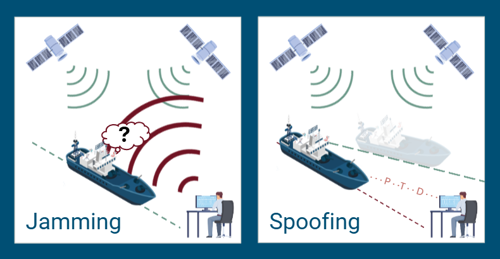
Spoofing, on the other hand, is where a device or software is used to transmit fake GNSS signals that are designed to deceive a ship’s GNSS receiver into computing and reporting a false position, navigation data or time (PNT).
Spoofing is viewed as the more serious threat to navigational safety as it leads to bridge crews relying on false data from the GNSS that appears to be valid. If a spoofing event goes undetected, it can negatively impact the ECDIS, AIS, track control functions and other systems that use GNSS data. This is why awareness, detection and cross-checking are critical.
How can ship operators prepare better and help crews react faster?
Modern vessels use GNSS data in far more places than most people realise, so understanding how GNSS information flows through the bridge is a good way to prepare crews for a jamming or spoofing event. Mapping which systems depend on GNSS input and understanding how these systems behave when data becomes unavailable or is unreliable helps crews to respond more quickly and with greater confidence.
"Ship operators should develop and document a GNSS resilience plan that sets out how connected systems behave during an attack and after recovery alongside recommended actions. This plan should be backed by comprehensive training for bridge crews and any other relevant personnel.” Jutta Blome, Product Line Manager Third Party Products, Sperry Marine

Let’s look at how Sperry Marine’s VisionMaster Radar and ECDIS work in the event of signal loss due to a GNSS jamming event. Both systems typically alert the operator and switch to dead reckoning mode to plot the vessel’s movement, meaning that the radar and ECDIS are relying on heading information from the compass and speed information from the speed log as inputs. It is therefore important that bridge crews know how these systems react in this situation.
For example, Sperry Marine’s NAVIGAT 200 spinning mass compass will continue to provide stable heading even if GNSS input is lost. The system will generate an alert, and in this situation crews should switch to manual position input. Sperry Marine’s NAVIKNOT 450D Doppler speed log can continue to provide speed information to connected systems without interruption.
"Sperry Marine’s products provide some of the key capabilities to support safe navigation during jamming and spoofing incidents. Our radar, ECIDS, compasses and speed logs are essential to continue sailing safely in case of GNSS interference.” Sandra Gassig, Product Line Manager Navigation & Steering, Sperry Marine

What technologies are available to improve resilience to jamming and spoofing events?
The most effective approach combines upgraded GNSS receiver technologies, signal authentication capability, and complementary navigation technologies. Let’s look at each of these in a little more detail.
Upgrade receiver technology
Ship operators can upgrade to modern receiver technology capable of handling multiple satellite constellations and frequency bands, which improves resilience to signal interference. There are also enhanced antenna configurations and advanced antenna technologies available that can reduce the impact of jamming and spoofing by mitigating unwanted signals.
In addition, many modern GNSS receivers include built-in interference monitoring and alert functions that help bridge crews to detect and respond to threats more quickly and effectively.
Implement signal authentication capability
Another way to improve resilience is to add the capability to authenticate GNSS signals. Galileo, the European GNSS service, has introduced Open Service Navigation Message Authentication (OSNMA), which adds a digital signature to standard Open Service navigation data. Compatible receivers can use this signature to verify that signals are from Galileo satellites. While authentication is not a catch-all solution, it does provide an additional level of trust.
Add complementary navigation technologies
Ship operators can also look beyond GNSS to add complementary navigation technologies that further improve resilience. Examples of such technologies include inertial navigation systems and emerging alternative PNT technologies. These provide additional sources of position, navigation or timing information and help maintain operational continuity during GNSS jamming and spoofing events.
Conclusion
GNSS jamming and spoofing are a clear and present operational risk that every ship operator should understand and prepare for, but there is no single technology that can address the problem. However, the aim is simple: to detect interference and alert the affected operators in time so that they can protect their navigation systems from using compromised data.
Achieving this aim requires a combination of measures, from improved GNSS technology, better bridge integration and alternative sensors to robust operational procedures. The important point is that there are practical steps that ship operators can take today to build resilience against jamming and spoofing events and support safer navigation.
Media Contacts
Sperry Marine
Sarah Barrett, Head of Marketing & Products
sarah.barrett@sperrymarine.com
About Sperry Marine
Sperry is a global leader in advanced navigation and control solutions for the maritime industry, driving innovation and safety at sea. Our heritage and expertise span decades, making us the trusted choice for commercial and military vessels worldwide. Our expertise is built on a legacy of innovation and precision - rooted in the pioneering work of historic brands such as Sperry Gyrocompass, C. Plath, and Decca Marine. Since 2001, Sperry Marine is proud to be part of Northrop Grumman Mission Systems.